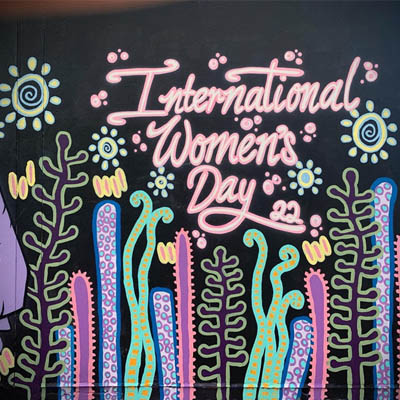
Today is International Women’s Day, a global celebration of the social, economic, cultural, and political achievements of women. The first such observance was in 1911 but gained popularity with the beginning of the Great War in 1914 as women across Europe held rallies opposing the war and expressing women’s solidarity. After some global discussion, it was agreed that International Women’s Day (IWD) would be marked annually on March 8th. While IWD has been observed on this day ever since it is interesting to consider the evolution of this day to celebrate and elevate women. Following the women’s movement of the 70s and the adoption of IWD by the United Nations, this day received very limited recognition. With some significant advancements and accomplishments by women, it seemed as if the world had moved on from the work of gender parity. However, in early 2001 the platform for IWD was re-energized to both celebrate the achievements of women and to renew the focus on equality.
This year, I am struck by the stories and images of the women most impacted by the tragic, unconscionable war being waged in Ukraine. I have read stories of teachers making Molotov cocktails. One woman, Kira Rudik, a member of the Ukrainian parliament, tweeted “I planned to plant tulips and daffodils in my backyard today. Instead, I learn to fire arms and get ready for the next night of attacks in Kyiv.” And the mothers. Oh, the mothers. The stories of mothers protecting their young children in bomb shelters and refugee camps. These women as well as the women left at home to care for children, siblings, and the elderly, struggle to remain strong and courageous while the war rages on. I also admire the bravery of angry Russian mothers, boldly speaking out, accusing the Kremlin of using their sons as “cannon fodder.” Some others assert that their soldier sons were duped. Their expressions of free speech come at great risk with probable imprisonment. These stories need to be highlighted on this International Women’s Day. These women are heroic.
As a teller of stories and a journalist by training, I am naturally drawn to books that recount noteworthy events, current and past. For the past few years, my reading list has increasingly featured women authors sharing the remarkable accounts of other heroic women figures from history whose lives are largely unknown. Women telling stories about women. On this International Women’s Day, I want to celebrate a few of these female writers whose titles I have read and a few that I am looking forward to reading. If you haven’t met these incredible NYT bestselling authors and tellers of women’s stories, allow me to introduce you to a few of the many.
In the category of “Want to Read,” I am looking forward to Her Hidden Genius, by Marie Benedict. Her upcoming new novel illuminates the life of Rosalind Franklin whose scientific work unlocks the secrets and structure of DNA. Ms. Benedict is the author of other books that feature women who are prominent in their own right but overshadowed by the men that surround them. I enjoyed her novel about Lady Clementine Churchill, wife of Sir Winston Churchill (Lady Clementine). I also read a fascinating fictional account of Belle de Costa Greene in The Personal Librarian co-authored with Victoria Christopher Murray. Best known for managing and collecting J.P. Morgan’s extensive library, Belle was a well-educated African American woman who spent her professional career precariously protecting her ethnicity by passing herself for white. This is an important story that casts light on an exceptional woman contending with both a male-dominated society and racism.
My reading wish list also includes new releases by other beloved writers of stories about tenacious women. Band of Sisters by Lauren Willig is based on the true story of a group of young women from Smith College who risk their lives and join a volunteer relief unit in France during World War I. During the early days of the pandemic, I discovereed author Elise Hooper, who amplified the 1936 women’s Olympic track team in Fast Girls. She finds her latest inspiration in the true World War II stories of American Army nurses serving in the Pacific and the unacclaimed participation of Filipinas of the resistance. Today is the publication release date for this new novel Angels of the Pacific. I relish a good spy novel, and Kate Quinn writes powerful stories of female spies in both World War I (The Alice Network) and World War II (The Rose Code). Her newest novel, The Diamond Eye is set in Kiev (Kyiv) during Hitler’s invasion of Ukraine and Russia. (I think this title will move to the top of stack position to read with the backdrop of current events and the modern-day women’s stories mentioned previously.)
Intriguing, bold women and female friendships are the subject of other novels I have read by female writers. Authors like Susan Meissner (The Fall of Marigolds, As Bright as Heaven, and The Nature of Fragile Things) and Patti Callahan Henry (Wild Swan, Becoming Mrs. Lewis, and Surviving Savannah) have helped me discover a wide range of women’s voices and perspectives. The stories they tell touch the tender, broken places that women often hide but manifest their intrepidity.
This past summer I became acquainted with the wonderful writer Kristen Harmel. I first met Ms. Harmel in the pages of her book The Book of Lost Names, one of many novels she has written to elevate the stories of women who were part of the resistance during World War II. I had the pleasure of meeting Ms. Harmel in person when she visited Cashiers, North Carolina to promote her most recent book The Forest of Vanishing Stars, inspired by stories of the survival of Jewish refugees living in the wilderness. At that time I had the privilege of introducing Ms. Harmel to founding leaders of the World War II Museum in New Orleans as well as a heroic 90-year-old woman who served in the French resistance when she was a teenager. This ignited a desire to read more of her novels about other valorous women. If you are not familiar with Ms. Harmel, I encourage you to read these titles as well as The Winemaker’s Wife, to celebrate the lives of women who through their perseverance not only survived tremendous struggle but discovered the true value of freedom, for themselves and others.
Women need to elevate and celebrate women. It is empowering when women tell the stories of women who have relentlessly pursued such freedom, inclusion, and equality for everyone, especially those whose voices have been dismissed or silenced.
It was Ms. Harmel who introduced me to another notable woman, Madame Clicquot. She was known as the “Grand Dame of Champagne.” Widowed at age 27, she took over her husband’s wine business at a time when women were not considered capable to do business, especially in the world of vintners. Yet, Widow (Veuve) Clicquot used her skill with wine in the early 19th century to develop and innovate the early champagne industry. The brand Veuve Clicquot still bears her name to this day. Another story of an accomplished woman that needs to be told and retold, and then remembered whenever we raise a glass of champagne in celebration.
On this International Women’s Day, let’s toast them all…the women whose stories we are familiar with…the women whose stories need to be told (and told again)…and the women whose stories need to be discovered so they can be told.
Write On

 Ann Self
Happy Woman’s Day…. A tribute to Womanhood…https://chapter18.wordpress.com/2010/07/17/the-great-indian-stitch-less-garment/
LikeLike
🙌🏻🙌🏻🙌🏻
LikeLike
It’s a storytelling episode by women on women. Wonderful! Thank you 😊
LikeLike